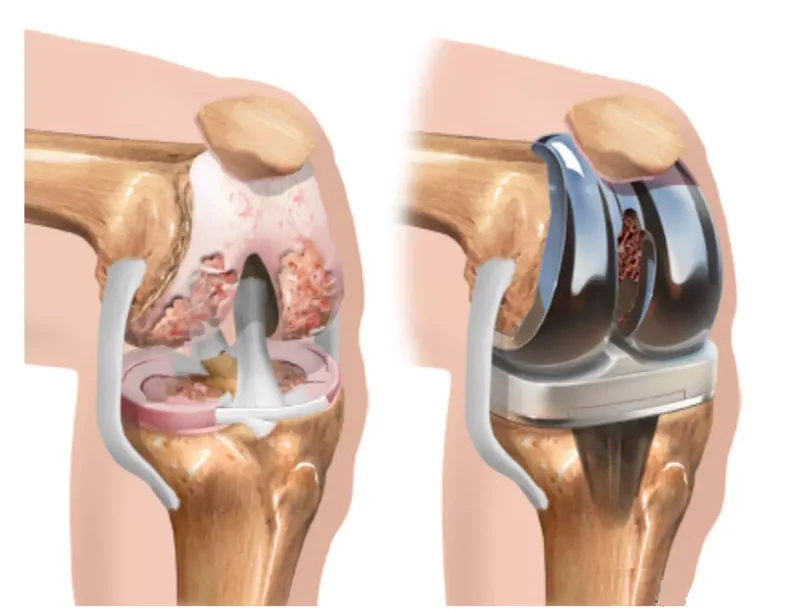

















Hip Replacement Surgery

What is a hip replacement?
A hip replacement is a metal implant, manufactured to suit the human body, surgically placed to take over the function of the hip joint in individuals whose hip joint has advanced osteoarthritis and can no longer perform its function.
Thanks to this prosthesis, the patient’s quality of life improves and meeting daily needs becomes easier. In particular, it allows for a reduction in pain, elimination of restricted movement, and resolution of leg shortening.
Who can have hip replacement surgery?
Hip replacement surgery is an operation that can be performed in many diseases affecting the joints, particularly above middle age. We can list these diseases as follows:
- Rheumatic diseases
- Osteoarthritis
- Hip dislocation
- Avascular necrosis
- Sequelae of infection
- Hip fractures in advanced age
- Tumors
Is there an age limit for hip replacement surgery?
There is no age limit for hip replacement surgery, which is generally performed after middle age. However, any patient who has completed or is about to complete bone growth can undergo the operation. Hip replacement surgery is frequently performed at age 60 and above.
What are the advantages of hip replacement surgery?
The hip replacement, which takes over the function of the hip joint, allows the patient to move comfortably and reduces joint pain, enabling a better quality of life. It has a very great effect on helping patients who once had to restrict themselves and went through a painful period to return to life.
What are the risks of hip replacement surgery?
As with every operation, this operation has risks. These risks are divided into two: during the operation and after the operation.
During the operation:
- Vascular and nerve injuries
- Failure to place the prosthesis properly
After the operation:
- Blood clot formation in a vessel
- Infection
- Loosening of the prosthesis
The items above are the main risks. However, thanks to advances in medicine and surgical techniques in recent years, risks are decreasing day by day and operations are being performed more comfortably and easily. Having the operation performed by a professional orthopedist in particular is the biggest factor that reduces the risk to a minimum.
How is hip replacement surgery performed?
It is ensured that the patient has no active infection, and a blood sample is taken and tests are performed. Then, after consulting the anesthesiologist and obtaining confirmation that there is no obstacle to surgery, the patient is admitted to the hospital the day before.
The surgery can be performed under general anesthesia or spinal anesthesia (numbing from the waist down). A skin incision of 10-20 cm is made over the hip, and the damaged bones are removed. A prosthesis is placed in place of the removed damaged bone and joint. Then, in order, the capsule, fascia, muscle, subcutaneous tissues, and skin are sutured, closing the operated area.
About 4-5 hours after surgery, the patient can begin eating normally by mouth. The day after surgery, patients begin walking with a walker.
How long does a hip replacement last?
With the development of the materials used over time, the lifespan of prostheses has increased. As a result of using surface coatings in prostheses that minimize friction, the lifespan of a hip replacement is approximately 20 to 25 years.
What should be considered after hip replacement surgery?
As after every surgery, there are a few things to be careful about. We can list some specific points to be considered especially after prosthesis surgery as follows:
During the 8-week period after surgery, the legs should not be crossed.
One should not bend down toward the floor while seated.
Because prostheses have a lifespan, care should be taken to avoid situations such as falls and impacts.
Light exercises can be started 4 weeks after surgery.
For heavy exercises, doctor approval and the limits set by the doctor must be observed.
How important is brand selection in hip replacement surgery?
The material and quality of the prosthesis used in the operation are of great importance in many respects. The brand of the prosthesis used greatly affects the lifespan of the prosthesis and the risk of loosening that may occur in the future.
In short, the better the brand of the prosthesis used, the higher its quality and the longer it lasts.
What material is a hip replacement made of?
The main parts are made of cobalt, chromium, or titanium, and where they articulate, it consists of plastic, metal, or ceramic parts.
Material selection is made so as to minimize friction. In this way, the prosthesis lasts longer and offers the patient a better quality of life.
Note: This text is for informational purposes; please follow your physician’s advice regarding your health condition.