
















Knee Replacement Surgery
What is a knee replacement?
Which patients is knee replacement surgery performed on?
Is there an age limit for knee replacement surgery?
What are the advantages of a knee replacement?
What are the risks of knee replacement surgery?
How is knee replacement surgery performed?
How important is brand selection in knee replacement surgery?
What material is a knee replacement made of?
How long does a knee replacement last?
How many degrees can a knee replacement bend?
What should be done after knee replacement surgery?
What is a knee replacement?
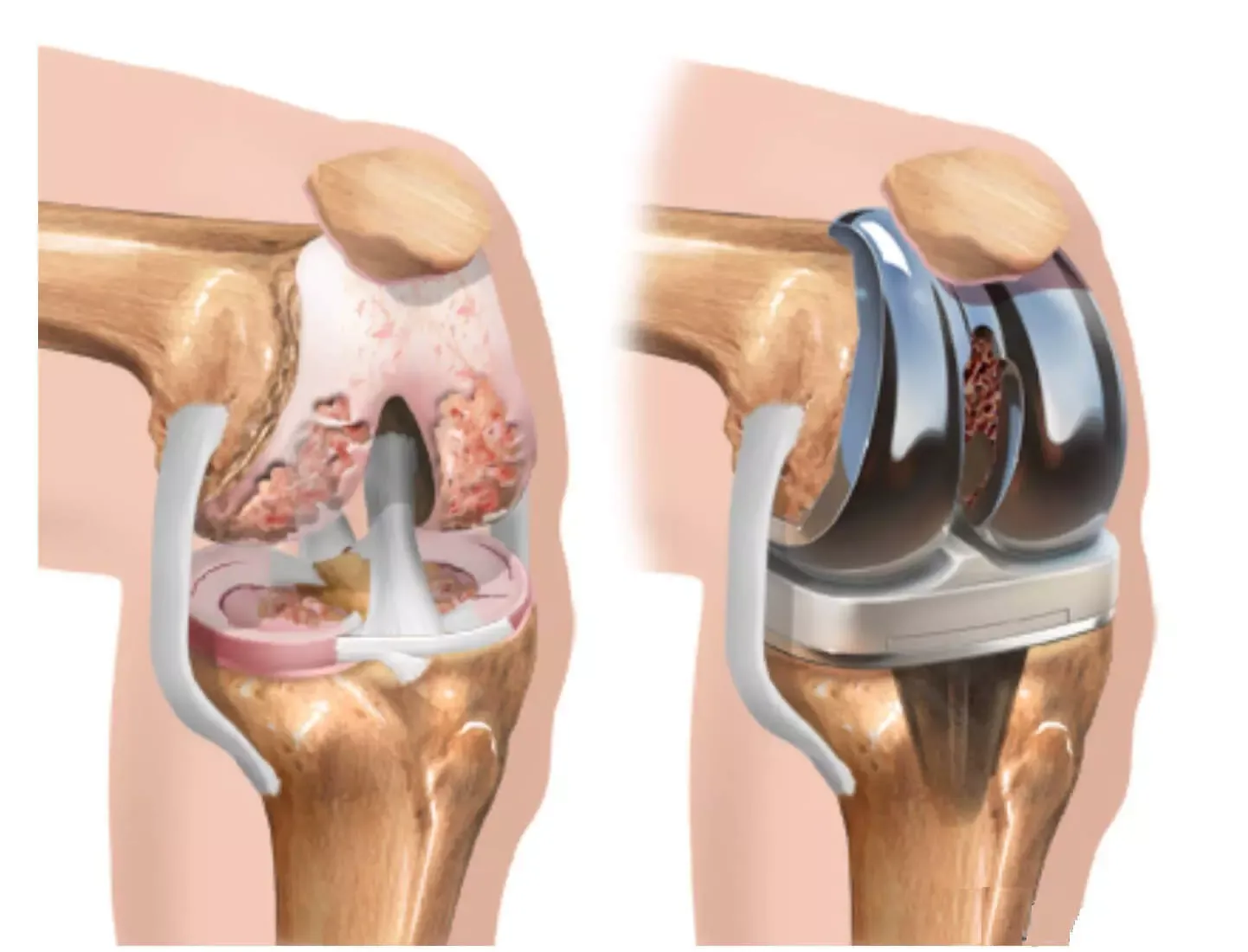
A knee replacement is an artificial component placed in place of the knee joint due to wear, degeneration, and deterioration in the knee, which imitates the function of the knee joint and makes it easier for the patient to move.
It is a surgical method that yields results, especially so that patients whose ability to use the knee joint is limited or completely lost can return to daily life and perform joint activity as before.
Which patients is knee replacement surgery performed on?
As we know, the joint-facing surfaces of bones are covered with hard, smooth cartilage tissue. In the joint space there is also joint fluid, which prevents the two bones from rubbing against each other. It is inevitable that this joint fluid decreases and the cartilage tissue wears down due to other causes as well. As a result of wear, the bones begin to rub against each other. This is exactly how what we call osteoarthritis occurs.
Knee replacement surgery is performed on patients with advanced joint wear. That is, the main goal is to improve living conditions by performing this procedure in patients with advanced osteoarthritis.
Is there an age limit for knee replacement surgery?
Although there is no age limit for knee replacement surgery, the aim is preferably to operate on patients aged 60 and over.
What are the advantages of a knee replacement?
Thanks to its many advantages, the knee replacement is a frequently used method today. We list these advantages as follows:
Increased range of motion
Return to an active life
Reduced pain
Long-lasting solution
What are the risks of knee replacement surgery?
As with every operation, knee replacement surgery involves certain risks. These can be listed as follows:
Infection
Loosening of the prosthesis
Edema in the knee joint and surrounding tissues With the development of implant technology and surgical methods today, risks and complications have been reduced to a minimum. In this way, safer and more positive results are obtained. In particular, the patient following the doctor’s recommendations after surgery eliminates postoperative complications to a great extent.
How is knee replacement surgery performed?
It is performed with an open surgical operation. Wear and osteoarthritis bone ends are cut and removed. Then, just like a dental crown, the prosthesis is fixed so that it covers the bone. Thanks to the prostheses attached to both bone ends, friction and contact between the two bones are prevented and pain is eliminated.
The operation takes about 1 to 1.5 hours. However, the duration of the surgery may vary depending on the patient’s condition and the prosthesis used.
Knee movements begin the day after the operation, and the patient is made to walk bearing weight on the leg. The patient is discharged from the hospital whenever they become able to walk comfortably. Although this period varies by patient, they are discharged on average between 3 and 5 days.
Are there different brand options for knee replacements?
There are many brands of knee replacements, both domestic and imported. However, in our clinic we prefer world-renowned, long-lasting imported knee replacements with which the best surgical results can be obtained.
What material is a knee replacement made of?
A knee replacement generally consists of chromium-cobalt alloys. This alloy is MRI compatible.
How long does a knee replacement last?
According to research, the lifespan of a quality prosthesis is projected to be 25 years.
How many degrees can a knee replacement bend?
Although the bending of a knee replacement varies from patient to patient, it can allow an average of 120 degrees of flexion.
What should be done after knee replacement surgery?
As after every operation, there are things to be careful about and to do after knee replacement surgery. We can list them as follows:
Wound care should be attended to because of the risk of infection Heavy sports should be strictly avoided Attention should be paid to bone and muscle health The physical therapy program should be followed and the given exercises should be done regularly Activities that strain the knee should be avoided unless there is doctor approval As long as the points mentioned above are observed, patients can continue their normal lives with a trouble-free and comfortable quality of life.
Note: This text is for informational purposes; please follow your physician’s advice regarding your health condition.